A Pench National Park tour is usually the last stop on a central Indian wildlife trip, and it is often the one guests tell us they underrated. Pench sits in the Seoni and Chhindwara districts of Madhya Pradesh, named after the Pench river, which flows north to south through the park and splits it into two almost equal halves. It is teak country: low hills on the southern side of the Satpura range, bamboo, the pale kulu trees and mahua. This is our guide to how the park works, when to go and how many nights to give it.
We plan safaris from our office in Jaipur, where we have been since 2005, and Pench appears on our two longest wildlife routes. What follows comes from those tour sheets and from the questions guests ask us before they book.
The Jungle Book connection, honestly
Every brochure calls Pench "the land of Mowgli". There is something to it. Rudyard Kipling set the Mowgli stories in the Seoni hills along the Waingunga river, and the Kipling Society notes that a village named in the books, Khanhiwara, is a real place on the Seoni–Mandla road. Pench Tiger Reserve lies largely in Seoni district.
The fine print: Kipling never went there. He wrote the stories in America, working mostly from second-hand accounts, above all Robert Sterndale's 1877 book on camp life in the Satpura range, based on his years in Seoni. The park itself did not exist yet; it became a sanctuary in 1965 and a national park in 1975. And Kanha, about four to five hours away by road, makes the same claim. We'd suggest you enjoy the story without paying a premium for it. Pench is worth visiting for the forest, not the legend.
How the reserve is laid out
On the Madhya Pradesh side, the official forest portal gives the tiger reserve a core of about 411 km² and a buffer of about 768 km², roughly 1,180 km² in all. The core combines the national park and the smaller Pench Mowgli Sanctuary. A separate Pench reserve continues across the state line in Maharashtra, with its own gates and its own booking system.
Most of our guests use the Madhya Pradesh side and its three core gates:
- Turia: about 85 km from Nagpur via Khawasa according to the forest department.
- Karmajhiri: about 135 km from Nagpur via Suktara.
- Jamtara: reached from the Chhindwara side, roughly 80 km from that town.
All three open onto the same core forest, so the choice of gate is mostly about where you sleep. On the Maharashtra side, gates such as Sillari and Khursapar have different weekly closing days. If you mix the two states in one stay, someone has to keep track of two calendars. It is worth settling which side you are on before anything is booked.
What you can see on a Pench safari
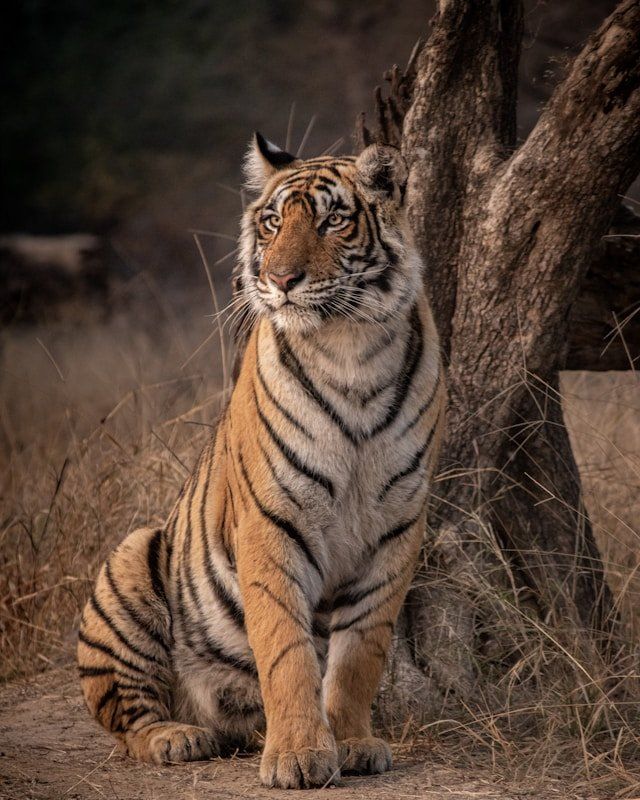
The tiger is the reason most people come, and Pench has a famous tigress in its recent past. T-15, known to everyone as Collarwali, was the first tigress fitted with a radio collar here, in March 2008. She went on to raise 29 cubs in eight litters between 2008 and 2018 and died in January 2022, aged about sixteen and a half.
Our tour sheets list chital, gaur (the Indian bison), sambar, nilgai, langurs, macaques, porcupine and fox, with the jungle cat if you are lucky. Leopards are here too, though shyer than the tigers. In April 2026 a safari group watched a leopardess walk down a park road with three cubs, which made the local papers. Dholes, the Indian wild dog, and sloth bears are also recorded. Pench rewards people who enjoy the whole forest, because the chital herds and open teak make for good viewing even on a morning without a big cat.
The honest downside is the one we give for every park: no sighting is guaranteed. We do not promise a tiger, and that includes Pench.
When to go
The core zone is closed for the monsoon, officially from 1 July to 30 September. In some years the reopening has slipped into the second or third week of October because rain damaged the forest tracks, so we would not build a trip around the first days of the season. Afternoon safaris on the Madhya Pradesh side do not run on Wednesdays, and they also stop on Holi and Diwali.
For comfort, mid-November to mid-February is pleasant, with cold, misty starts that need a proper jacket in an open jeep. For tigers, most guides point to March and April, when the forest thins and animals gather at the remaining water. The trade-off is heat. If you can only manage one window, we'd suggest late February to March: still bearable, already good for sightings.
A real Pench stay: our 20-day wildlife route
On our 20-day wildlife itinerary, Pench comes after Bandhavgarh and Kanha. This is how those last days run on the sheet:
Day 17: Kanha to Pench
After breakfast you leave Kanha by road. The sheet gives 200 km in four hours; tourism sources put it nearer 220 km, so on Indian roads we tell guests to expect closer to five. You check in and the rest of the day is yours.
Day 18: two drives in the park
An early start at 6.00 for the morning safari, back to the lodge for breakfast and a shower, time to yourself until lunch, and then out again for the afternoon drive.
Day 19: Pench to Nagpur, flight to Delhi
Breakfast at 7.30, then the drive to Nagpur airport, about two to three hours, for the flight to Delhi, which takes roughly an hour and forty minutes to two hours. The afternoon goes on Humayun's Tomb, Raj Ghat and Lutyens' Delhi before your flight home the next day.
Our longer 28-day wildlife itinerary gives Pench four nights instead of two, with three full days of morning and afternoon drives. If Pench is your main park rather than the last of several, that is the pace we recommend.
How many nights, and what we advise against
Our advice is simple: at least two nights and three or four drives, and more if Pench is your only tiger reserve. We advise against squeezing it into a single night on the way to Nagpur. One afternoon and one morning is not enough in any park, and an early-October date can leave you with buffer drives only if the core opens late.
Getting there is the other real drawback. There are no direct flights from the UK to Nagpur. From London, a non-stop flight to Delhi takes about eight and a half to ten and a half hours, and you then need a domestic connection and the road transfer. That is why most guests combine Pench with Bandhavgarh and Kanha rather than flying in for Pench alone. If you are weighing a park closer to Delhi instead, our guide to Jim Corbett National Park covers the other option.
The long road days are much easier with a driver who knows the route. As Michael, from Luxembourg City, wrote on TripAdvisor in February 2026: "A special thanks to my driver, Dhara, who took wonderful care of me and navigated the lively chaos of Indian traffic with calm confidence." You can read more from guests on our reviews page, and see the vehicles we use for these transfers on our car with driver page.
For the park itself, see our Pench destination page, and for the other reserves we plan, our wildlife destinations and the full list of wildlife tours. Before you book flights, check the e-Visa steps in our India visa guide for UK, US and EU travellers.
Pench National Park tour: quick answers
Which airport is closest to Pench?
Nagpur. The Turia gate is about 85 km away by road, so allow two to three hours. Jabalpur is the other option if you are arriving from Kanha or Bandhavgarh.
Is Pench open all year?
No. The core zone closes from 1 July to 30 September, and the reopening can slip into mid-October. Afternoon safaris on the Madhya Pradesh side do not run on Wednesdays.
Is Pench really the Jungle Book forest?
Kipling set the stories in the Seoni area, and much of Pench lies in Seoni district, but he never visited and the park was created long after. Kanha makes the same claim.
Is Pench good for a first tiger safari?
Yes, if you give it at least two nights. The forest is lovely and the wildlife varied, but no sighting is guaranteed anywhere.
If you would like Pench on your own route, with or without Kanha and Bandhavgarh, send us your dates and we will plan it with you.