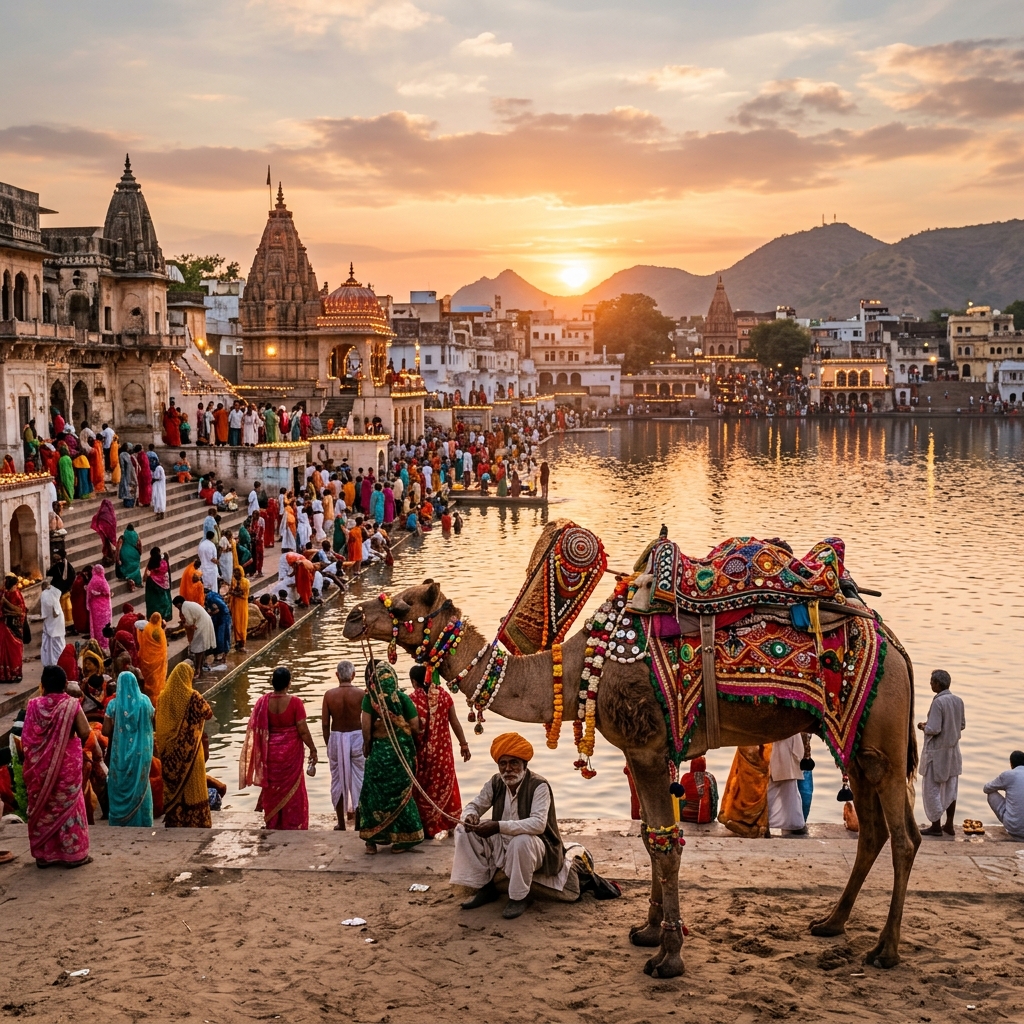
Every November, a quiet temple town of about twenty thousand people in central Rajasthan takes in something close to two hundred thousand visitors, along with tens of thousands of camels, horses and cattle. For a week, the sand flats north-west of Pushkar's lake turn into the largest livestock fair in Asia, and one of the most photographed gatherings on earth.
We have been sending guests to Pushkar from our Jaipur office for twenty years. In that time we have learned that the fair rewards people who understand what they are walking into, and quietly disappoints those who arrive expecting a tidy cultural performance. This is our honest guide to both.
When the fair happens, and why the dates move
The Pushkar Camel Fair follows the Hindu lunar calendar, not the Gregorian one, so it lands on different dates each year. It always concludes on Kartik Purnima — the full moon of the month of Kartik — which falls in late October or November. The livestock trading starts roughly eight days before that and winds down as the religious days take over.
In 2026 the fair runs 17th-24th Nov., with Kartik Purnima on 23rd-24th Nov.
That structure matters more than the calendar, because the fair is really two events sharing one week.
The two halves of the fair
The trading days, at the beginning
The first half belongs to the herders. Families walk their camels in from across Rajasthan and beyond, set up camp on the dunes, and trade. There are no barriers and no ticketing — you walk out onto the sand among thousands of animals and the people who have raised them. Camels are decorated, shorn into patterns, and sold. Deals are struck over tea.
If you have come for photographs, or for the fair as a working livestock market rather than a spectacle, arrive early in the week. This is the part that people mean when they say Pushkar is unlike anywhere else.
The pilgrimage days, at the end
As the trading thins out, the religious fair builds. Pushkar's lake is one of the most sacred sites in Hinduism, and on Kartik Purnima pilgrims come in enormous numbers to bathe at the ghats at dawn. The town fills, the streets narrow with people, and the atmosphere shifts from commerce to devotion.
The competitions and staged events — camel races, moustache and turban contests, the "matka phod" — cluster in the middle and later days. They are genuinely enjoyable, but be clear-eyed: these are organised for visitors. The trading grounds at first light are the real thing.
If you can only manage two mornings, make them the first two. The animals are at their most numerous, the light is best, and the crowds have not yet arrived.
Where to stay when the whole town is full
Pushkar's permanent hotels are small, and they are spoken for a year ahead. There are three realistic options.
- Tented camps. Dozens of camps go up for the fair, ranging from basic canvas with shared facilities to genuinely comfortable tents with proper beds, attached bathrooms and running hot water. The good ones sell out by late summer. This is the option we book for most guests, because being able to walk to the fairground at 6am is the whole point.
- Ajmer, 15 km away. More conventional hotels, a half-hour drive each way, and an easier landing if you want reliable comfort. The trade-off is that you will not be on the sand at sunrise.
- Day trips from Jaipur. Around three hours each way. It works if the fair is one stop in a wider Rajasthan trip, but a very long day, and you will miss the two hours that matter most.
Whichever you choose, book early. We start confirming Pushkar accommodation for our guests in the first half of the year, and by September the good camps are gone.
How Pushkar fits into a longer trip
Almost nobody flies to India for Pushkar alone, and nor should they. The town sits conveniently between Jaipur and Udaipur, which makes it a natural two-night stop in the middle of a Rajasthan route.
The combinations that work well:
- With the Golden Triangle. Delhi, Agra and Jaipur, then two nights at the fair before flying home. Roughly ten days. See our Golden Triangle itineraries.
- Inside a wider Rajasthan loop. Jaipur, Pushkar, Jodhpur, Jaisalmer and Udaipur, with the fair setting the dates for everything else. Two to three weeks. See our Rajasthan tours.
- With wildlife. Ranthambore is at its best in the cool months, and slots in neatly after Jaipur.
One planning note: because the fair fixes your dates, we build the rest of the itinerary backwards from it. That is the opposite of how most trips are planned, and it is worth starting early.
The honest practicalities
We would rather you arrive prepared than delighted by a brochure.
- It is dusty. Thousands of animals on dry sand, all week. Bring a scarf, and if you use a camera, something to keep the sensor clean.
- The days are warm, the nights are cold. Pleasant afternoons in the mid-twenties Celsius; genuinely cold before dawn in a tent. Layers, not a single warm coat.
- Pushkar is a temple town. No alcohol, no meat, no eggs anywhere in town. Dress modestly, and remove shoes near the ghats.
- Photograph people properly. Ask first. Herders are generally welcoming, but the fair is their livelihood, not a set. If someone asks for money after a portrait, that is a fair negotiation, not a scam — agree it beforehand.
- Crowds are real. On the final days the town is close to impassable in places. Anyone with limited mobility should plan for the earlier days.
- It is not a children's fair, though children who like animals often love the trading grounds first thing in the morning. The evening crowds are the harder part.
Is it worth it?
If you want a comfortable, curated cultural experience, there are gentler ways to see Rajasthan, and we will happily plan one. If you want to stand on a cold dune at sunrise while ten thousand camels wake up around you, and to see a piece of rural India that has not been arranged for anybody's benefit, then there is nothing else quite like it.
Our own view, after twenty years: go for the first half of the week, stay two nights, and let the rest of the trip be built around it.
If you are considering the fair for this year, tell us your dates and we will tell you honestly what is still available. You can also read more about the fair's history and traditions on our Pushkar Camel Fair page.