Whenever someone asks me what they should eat in India, I never quite know where to begin. There is simply too much to choose from. And the first thing I usually tell visitors is that Indian food is not really one cuisine. It changes every few hundred kilometres, sometimes even from one family to another.
I also like to tell them that Indian food is much more than curry, butter chicken and mango lassi and something very spicy.
For me, Indian food begins at home.
A simple everyday Indian meal can be dal (lentil soup), a seasonal vegetable, rice and roti. Roti is our everyday bread in many Indian homes — made from wheat flour, rolled by hand and cooked fresh. It is not something we think of as special. It is simply part of an ordinary lunch or dinner, often eaten with some curd, pickle or chutney.

And then there is chai.
I sometimes think chai deserves its own category in Indian culture. We don't just drink it; we build little moments around it. When someone comes home, we offer chai. When friends sit together, there is chai. When there is something important to discuss, there is chai. Even when there is absolutely nothing to discuss, there is Chai. It is our morning espresso and evening aperol spirtz.

A cup of chai is often accompanied by something to eat — perhaps biscuits, namkeen, a samosa or a kachori. Namkeen is a whole world of Indian savoury snacks: crunchy mixtures of sev, peanuts, lentils and spices that somehow disappear much faster than you expect.

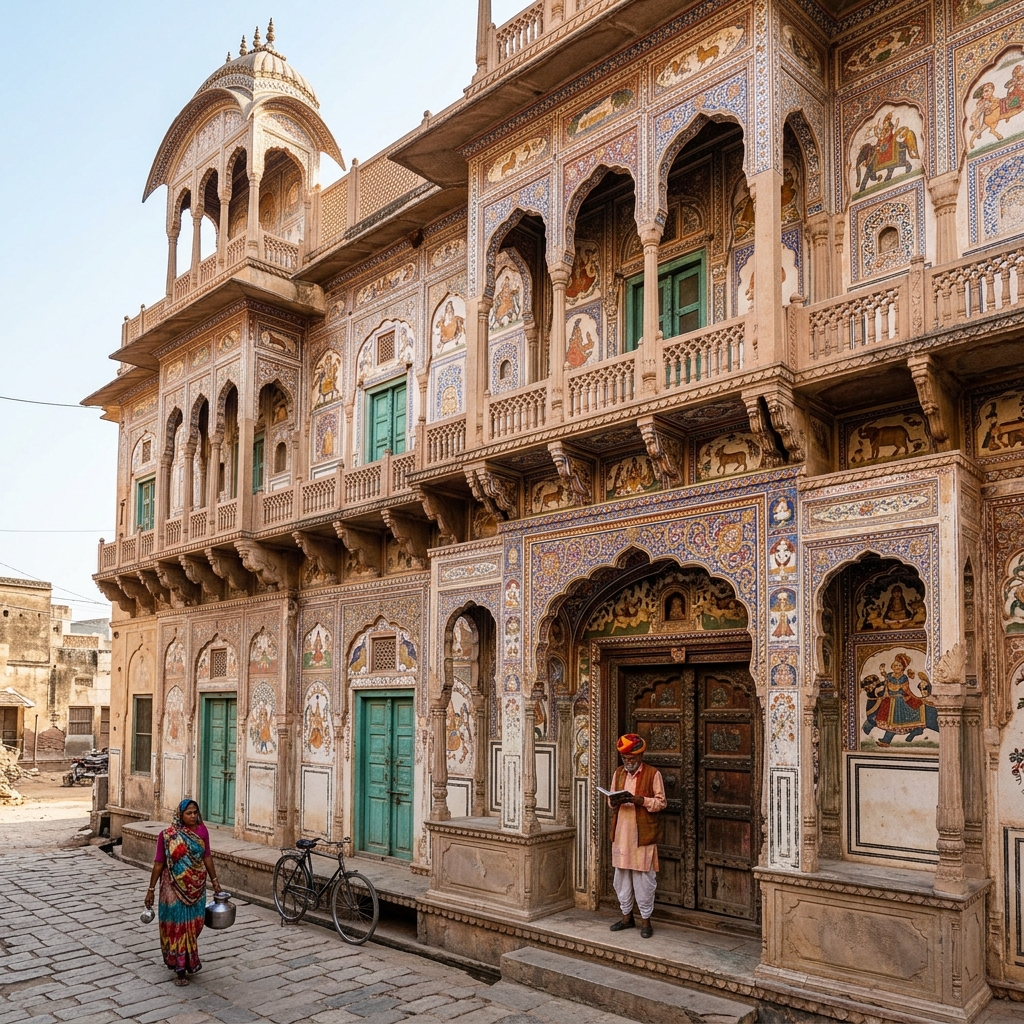
If you are travelling through Rajasthan, there are a few things I would especially want you to try. Dal baati churma is one of them. It is hearty, rustic and completely different from the restaurant-style Indian food that many visitors may already know.
And please don't assume that everything in India is spicy.
This is one of the biggest misconceptions I come across. We use a lot of spices, but spices don't always mean chilli. Cumin, cardamom, cinnamon, garlic, ginger and turmeric are used to create flavour and fragrance too.
There are plenty of mild foods to enjoy. A fragrant biryani accompanied with flavored yogurt can be aromatic rather than hot. Lassi is cool, creamy and refreshing, especially on a warm day. And then there is dahi vada, raj kachori, khamman dhokla, one of my favourite kinds of chaats — It is sweet, sour, savoury and refreshing all at once.


Then come the sweets.
Indians don't really need an excuse for sweets, but our festivals and seasons give us plenty of them. In Rajasthan, ghewar is something I particularly associate with the current season, the monsoon. When the rains arrive and festival of Teej approaches, you start seeing this beautiful honeycomb-like sweet everywhere. Then there is Gulab jamun, Rasgulla, Kaju Katli, Gajar (carrot) ka halwa in winters, and so many types of Laddoos, from besan laddoo to motichoor laddoo, its like the Indian tiramisu in so many flavors.


And that is something I love about Indian food. It is tied to our seasons, festivals, memories and family traditions.
Food is also one of the most important ways we welcome people and that is why India Karni hosts you at home in Jaipur during your trip.
When you come to an Indian home, there is a very good chance someone will ask if you have eaten. And even if you say yes, they may still bring something out. You can say, “No, thank you, I'm full,” but your Karni may respond with, “Just try a little.”
I have grown up seeing this kind of hospitality, and I think it is one of the easiest ways to understand India. We don't always say, “I'm happy you came.” Sometimes we simply put another roti on your plate.


There is another side to Indian food and drink too. India has its own drinking culture, with familiar Indian brands such as Kingfisher beer and Old Monk rum, which have become part of modern Indian social life. And during certain festivals, you may come across bhang, a traditional cannabis preparation associated particularly with celebrations such as Holi and Shivratri. Its legal status varies by state, so travellers should always check local rules.
But if I had to explain Indian food to someone who has never been here, I wouldn't start with a list of dishes.
I would tell them to sit down at an Indian dining table.
Have a roti with dal. Try the kachori. Share some namkeen over chai. Eat a little too much ghewar during the monsoon and if you are at Karni's house loads of Indian beer Kingfisher Ultra before the food comes. Try something spicy, and then something mild. Ask where the recipe came from.
Because eventually, you realise that Indian food is not simply about what is on your plate.
It is about the person who made it, the family sitting around you, the festival being celebrated, the season outside the window and the stories that come with every dish.
And perhaps that is why, in India, “Have you eaten?” can sometimes be our way of saying, “You are welcome here.”