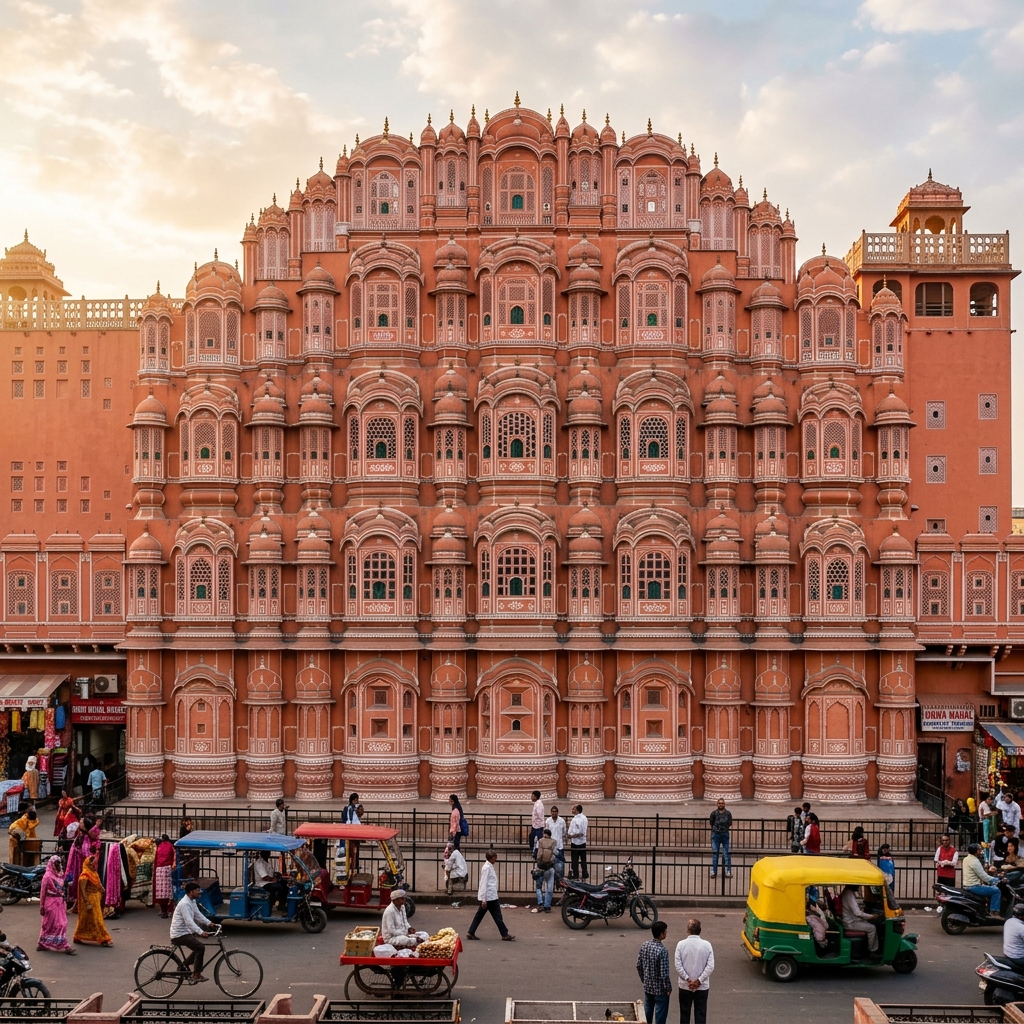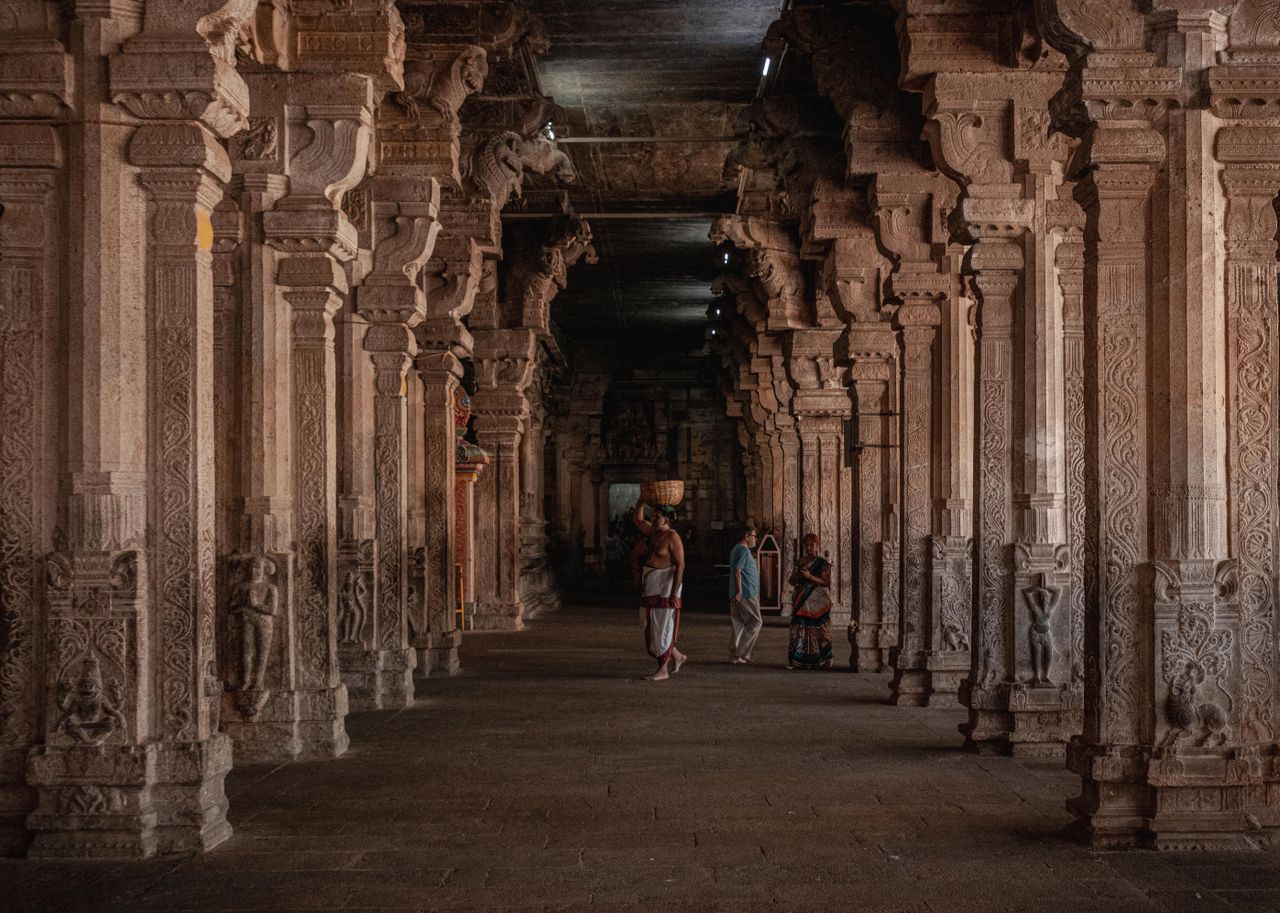
Most people who book Rajasthan with us have never heard of Shekhawati. It does not appear on the Golden Triangle, it has no fort worth queuing for, and the coaches drive straight past it on the way to Bikaner. What it has instead is several hundred merchant houses painted inside and out with frescoes, standing in small towns that have barely changed shape in a century.
We send guests there when they have two weeks rather than one, or when they have already seen Jaipur and Udaipur and want the part of Rajasthan that is still ordinary.
What a haveli actually is
In the eighteenth and nineteenth centuries this region produced the Marwari trading families — Birla, Goenka, Poddar, Dalmia — who went on to build much of Indian industry. They made their money in Bombay and Calcutta and sent it home to build houses.
A haveli is a courtyard mansion, and in Shekhawati the competition between families ran to the walls. Every surface got painted: gods and processions on the older ones, then trains, motor cars, gramophones, aeroplanes and Europeans in hats as the painters started copying whatever the merchants described from the cities. You can date a wall roughly by what is on it. That is what makes these towns worth a day — not one great monument, but a few hundred houses arguing with each other in paint.
Getting there
- Jaipur to Mandawa — about 170 km, three to three and a half hours.
- Delhi to Mandawa — around six hours, which makes it a viable first stop instead of Jaipur if you want to start somewhere quiet.
- Mandawa to Bikaner — roughly three and a half hours, which is why it fits so neatly on a Rajasthan loop heading towards the desert.
Nawalgarh, Fatehpur and Mahansar are each about half an hour from Mandawa, so one base covers the region. We usually put guests in Mandawa itself.
Mandawa: what to see in a day
The town itself
Mandawa is small enough to walk. The main bazaar street has painted facades along most of its length, and the pleasure of the place is turning down side lanes rather than ticking off a list. Go early — the light is better and the frescoes on east-facing walls are lit until about ten.
The havelis worth going inside
The Aath Haveli complex, the Chokhani, Jodhraj Patodia and Bansidhar Bhagat havelis are the usual circuit. The Morarka Haveli Museum is the most organised of them.
A practical warning: most of these are privately owned, and opening hours, entry fees and whether anyone is there to unlock the door change without notice. Budget somewhere around ₹250 a person for the ones that charge, expect a caretaker to appear and expect at least one closed door. This is not a ticketed monument circuit and it does not behave like one.
Nawalgarh, half an hour away
If you only add one more town, make it Nawalgarh for the Dr Ramnath A Podar Haveli Museum, built in the 1920s and properly restored. It is the clearest picture of what these houses looked like when the paint was new, and it makes everything you see afterwards easier to read.
How to read a wall
Ten minutes of knowing what to look for changes the whole day.
- Start with the subject. Krishna, Rama and wedding processions are the older layer. Trains, bicycles, telephones, gramophones and aeroplanes came later, as the merchants sent home descriptions of things the painters had never seen. That is why the trains sometimes have the wrong number of wheels and the Europeans are drawn with the stiffness of gods.
- Then the colour. The early work uses natural pigment — indigo blue, ochre, lime white — and it has faded evenly. The bright synthetic greens and purples arrived at the end of the nineteenth century and sit oddly against the rest.
- Then the geography of the house. The outer courtyard was where the merchant received business, and its paintings are for show. Go through to the inner courtyard, where the family lived, and the subjects turn domestic and often more skilful, because nobody was competing there.
- Look above the doorways. The best small panels are almost always over the entrance arches, at a height nobody photographs.
Where to stay
Mandawa has the best hotels in the region, several of them converted havelis and one converted castle. Staying inside a painted courtyard is most of the point — the alternative is a day trip from Jaipur, which means seven hours of driving for four hours of looking, and we generally talk people out of it.
How it fits into a longer trip
Shekhawati is a link, not a destination on its own. The two routes that work:
- Delhi → Mandawa → Bikaner → Jaisalmer — the northern desert run, with Shekhawati as the soft landing before the sand.
- Jaipur → Mandawa → Bikaner — added to a standard Rajasthan loop, costing one extra night.
It goes badly as a detour squeezed between Jaipur and Udaipur — that is the wrong direction entirely, and we have watched people try. If you are building a longer route, our guide to the best time to visit Rajasthan covers which months suit the desert leg.
When to go
October to March, like the rest of Rajasthan. Shekhawati is drier and more open than the south of the state, so the winter mornings are genuinely cold — December and January want a jacket before nine. April onwards is hot and the walking, which is the whole activity here, stops being pleasant.
Common questions
Is one day enough for Shekhawati?
One full day and one night in Mandawa covers the town and one neighbouring village comfortably. Two nights lets you add Nawalgarh and Fatehpur without rushing, which is what we would suggest if frescoes are the reason you came.
Can I do it as a day trip from Jaipur?
You can, and we would rather you did not. Seven hours in the car for four on foot, and you miss the evening light, which is when the western walls come alive.
Do I need a guide?
More than anywhere else in Rajasthan, yes. Unguided, the paintings are decorative; with someone who can read them, you start seeing which family was showing off, which wall was repainted after a son went to Calcutta, and why there is a steam train above a doorway in a town that never had a railway.
Are the havelis in good condition?
Honestly, mixed. Some are beautifully kept, some are lived in and patched, and a few are falling down with families long since moved to Mumbai. That unevenness is part of what the place is. If you want restored perfection, the Podar museum in Nawalgarh is where to find it.
Is it suitable for older travellers?
Yes, with the caveat that this is a walking destination on uneven lanes, and the havelis have steep stairs. The car can meet you between clusters rather than waiting at one end.
Adding Shekhawati to your trip
We build this region into Rajasthan itineraries as a matter of course when there is time for it — you can see the range on our Rajasthan tours page. If you would rather tell us your dates and let us put the route together, send us your plans and you will have a day-by-day itinerary and a price within 24 hours, free and with no obligation.