Most people who come to Rajasthan in November head for Pushkar. Fair enough: the camel fair is huge, loud and photogenic. But a few hours east, in a small town under a hill fort, there's a festival that runs in the same month and gets a fraction of the visitors. Bundi Utsav is what we suggest to guests who've already done Pushkar, or who simply don't want to share a sunrise with ten thousand phones.
It isn't a polished show. Some events start late, the stage announcements are in Hindi and Hadoti, and the schedule sometimes changes the evening before. We still think it's one of the best things you can do in Rajasthan in late autumn.
What is Bundi Utsav?
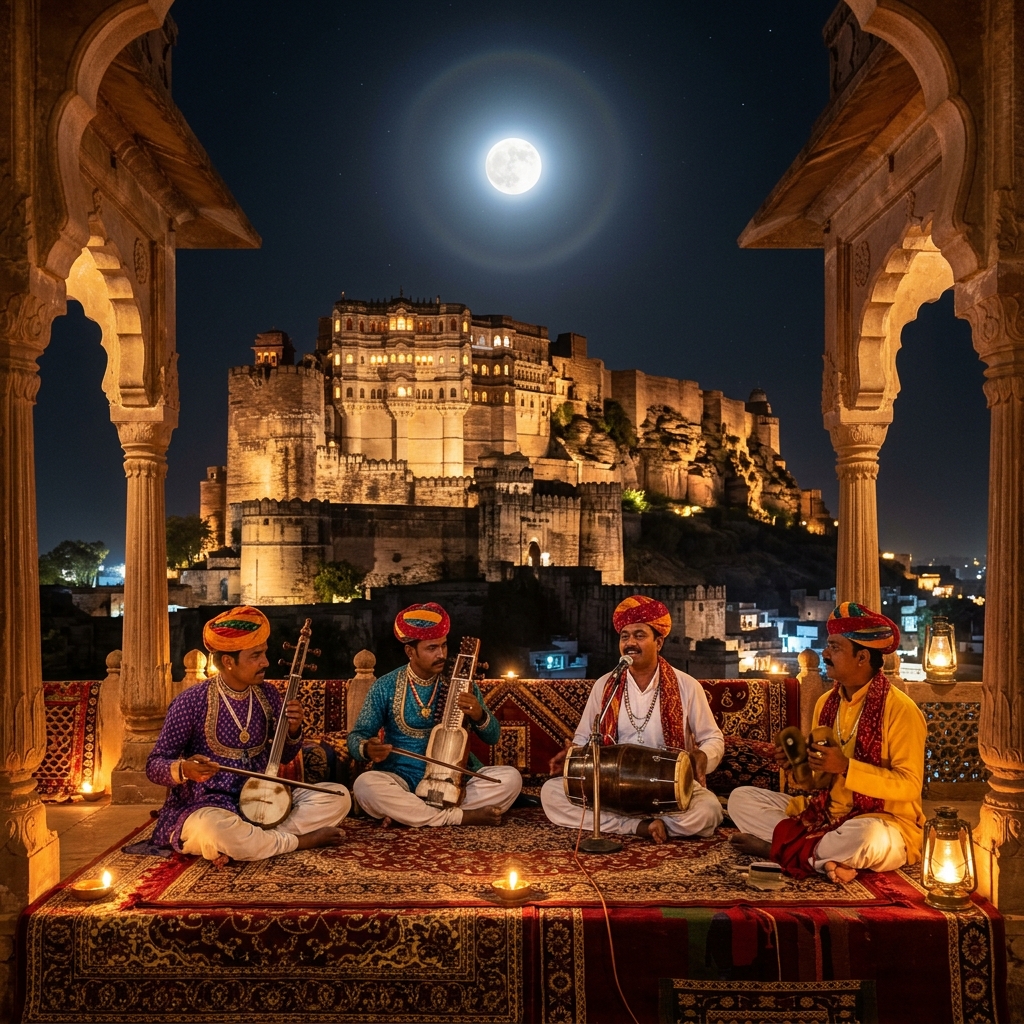
Bundi Utsav is a cultural festival organised by the district administration and Rajasthan Tourism in Bundi, the old capital of the Hada Rajputs. It lasts a few days and mixes a town procession, folk music and dance, craft stalls, rural sports and competitions (turban tying and moustaches are the crowd favourites), with evening performances and fireworks.
The part that makes it special happens outside town. On the morning after the Kartik full moon, people gather on the banks of the Chambal at Keshoraipatan and float small lamps, many of them shaped by hand from flour dough, on the water. Locals sometimes call Keshoraipatan a "mini Pushkar". It's a fair comparison in spirit, just much smaller.
When is Bundi Utsav 2026?
The festival follows the Hindu month of Kartik, so it moves every year. In 2025 it ran on 18 to 20 November. In 2026 the Kartik full moon (Kartik Purnima) falls on 24 November, so expect the festival somewhere in the second half of November. Several websites already list precise 2026 dates, but they don't agree with each other, and the district usually publishes the official programme only a few weeks ahead.
Our advice: plan for the last ten days of November and keep one flexible night. We confirm the programme with our contacts in Bundi before we lock in hotel nights for guests.
Why Bundi is worth the detour even without a festival
Bundi is the town that people who love Rajasthan tend to talk about quietly. The blue houses climb the hill below Taragarh Fort, the lanes are too narrow for tour buses, and the palace murals are some of the finest in the state.
- Garh Palace and the Chitrashala. The palace itself is partly crumbling. The Chitrashala, a small courtyard of painted rooms, is the reason to go: blue and green murals of Krishna, court scenes and processions. Bring a torch for the darker corners.
- Taragarh Fort. A steep, rough walk above the palace. It's overgrown and full of monkeys, so leave food in the car and carry a stick if the caretaker offers one. The views over the town are worth the sweat.
- Raniji ki Baori. A deep, carved stepwell right in town, with elephant brackets and fine stonework. Go early, before the school groups.
- Sukh Mahal and Jait Sagar. A small summer pavilion on a lake, linked to Rudyard Kipling, who stayed in Bundi. Pleasant at sunset.
- Chaurasi Khambon ki Chhatri. A cenotaph on 84 pillars, a short drive out. Quiet, and often overlooked.
Two full days covers the town comfortably. With the festival on, give it three.
How we'd spend three days at Bundi Utsav
Day 1: arrive, walk, find your bearings
Jaipur to Bundi is about 4 hours on the NH52, a little more if the driver stops for chai at a dhaba near Tonk (he will, and you should join him). Check in by early afternoon, walk the lanes around the palace, and look at the printed programme at the tourist office or ask your hotel. Evening performances usually start after dark. They start "after dark" in Rajasthani time, so eat something first.
Day 2: the town side of the festival
Morning at the Chitrashala and Raniji ki Baori while the crowds are still at breakfast. The procession, craft fair and competitions tend to run from late morning. The turban-tying contest is genuinely fun to watch, and foreigners are sometimes invited to join. Don't feel obliged. Late afternoon, head up to Sukh Mahal, then back for the cultural programme and fireworks.
Day 3: Keshoraipatan at dawn
This is the morning we'd never skip. Keshoraipatan is roughly 45 minutes to an hour from Bundi, and you want to be there before first light. It's cold at that hour in late November (think 10 to 12°C), so bring a fleece. The ghats smell of wet stone, marigolds and ghee smoke. Women in their best saris set lamps on the river, and the Chambal slowly fills with small flames drifting downstream. Keep your camera flash off and your distance polite. Back in Bundi by mid-morning, you can rest, then continue your trip in the afternoon.
Where to stay in Bundi
Bundi doesn't do big hotels. Most rooms are in heritage havelis and family guesthouses near the palace, and during the festival the good ones fill early. Expect roughly INR 4,000 to 12,000 (about USD 50 to 145) a night for a comfortable haveli room in festival season, less for simpler guesthouses. Rooms with a view of the palace are worth paying a bit more for.
A few honest notes: hot water can be slow in old buildings, walls are thin, and temple loudspeakers start early. If you're a light sleeper, pack earplugs. Some guests prefer to stay in Kota (about 40 km away) for a modern hotel, but you lose the evening atmosphere, so we don't recommend it unless the town is full.
How Bundi fits into a Rajasthan route
Bundi sits neatly between Jaipur and Udaipur, which is exactly why it works. A route we build often looks like this: Jaipur, Bundi (2 or 3 nights), Chittorgarh (1 night, or a long stop), then Udaipur. Bundi to Chittorgarh is around 3 hours, and Chittorgarh to Udaipur another 2 to 2.5 hours. It breaks up a long drive that would otherwise be a full day in the car.
If you want both festivals, it's possible to combine Pushkar and Bundi in one trip, but the dates are close and both peak around the full moon. Read our Pushkar Camel Fair guide first, then decide which one gets the full moon morning. You can't be at both. For more on the season in general, our post on the best time to visit Rajasthan covers weather month by month.
For this kind of route, an Innova Crysta is what most couples and small families end up in. The roads between Bundi and Chittorgarh are mostly fine, but some village stretches near Keshoraipatan are bumpy, and the higher seats help. See the Innova Crysta with driver page for what's included.
Practical things nobody tells you
- Cash matters. ATMs in Bundi do run out during festival days. Carry enough small notes for tea, stalls and parking.
- Dress modestly, especially at Keshoraipatan. Shoulders and knees covered is the simple rule.
- Photography of people: ask. Most will say yes with a smile. A few won't, and that's fine.
- Toilets at event venues are basic at best. Plan around your hotel.
- The stage programme is not really designed for tourists. That's part of the charm, but a local guide makes a real difference to what you understand.
FAQ
Is Bundi Utsav free to attend?
The public events we've seen are free. Monuments like Garh Palace and Taragarh charge their usual entry fees, which change from time to time, so check at the gate.
How many days do I need?
Three nights is ideal if you want the town, the festival evenings and the Keshoraipatan dawn. Two nights works if you're tight on time, as long as one of those mornings is the one after the full moon.
Is Bundi Utsav crowded?
Busy, yes, especially in the evenings and at Keshoraipatan. Crowded like Pushkar, no. You'll still find quiet lanes a few minutes from the stage.
Can I combine Bundi Utsav with Pushkar Camel Fair?
Yes, with care. Both follow the Kartik calendar, so the key days overlap. Most guests do Pushkar's early days and then move to Bundi, or the other way round. We plan this once the official dates are out.
If Bundi Utsav sounds like your kind of festival, tell us your dates and how you like to travel, and we'll build a route around the full moon with the right hotels and a driver who knows the back roads. Start with our enquiry form, or browse the Bundi festival page for an overview first.