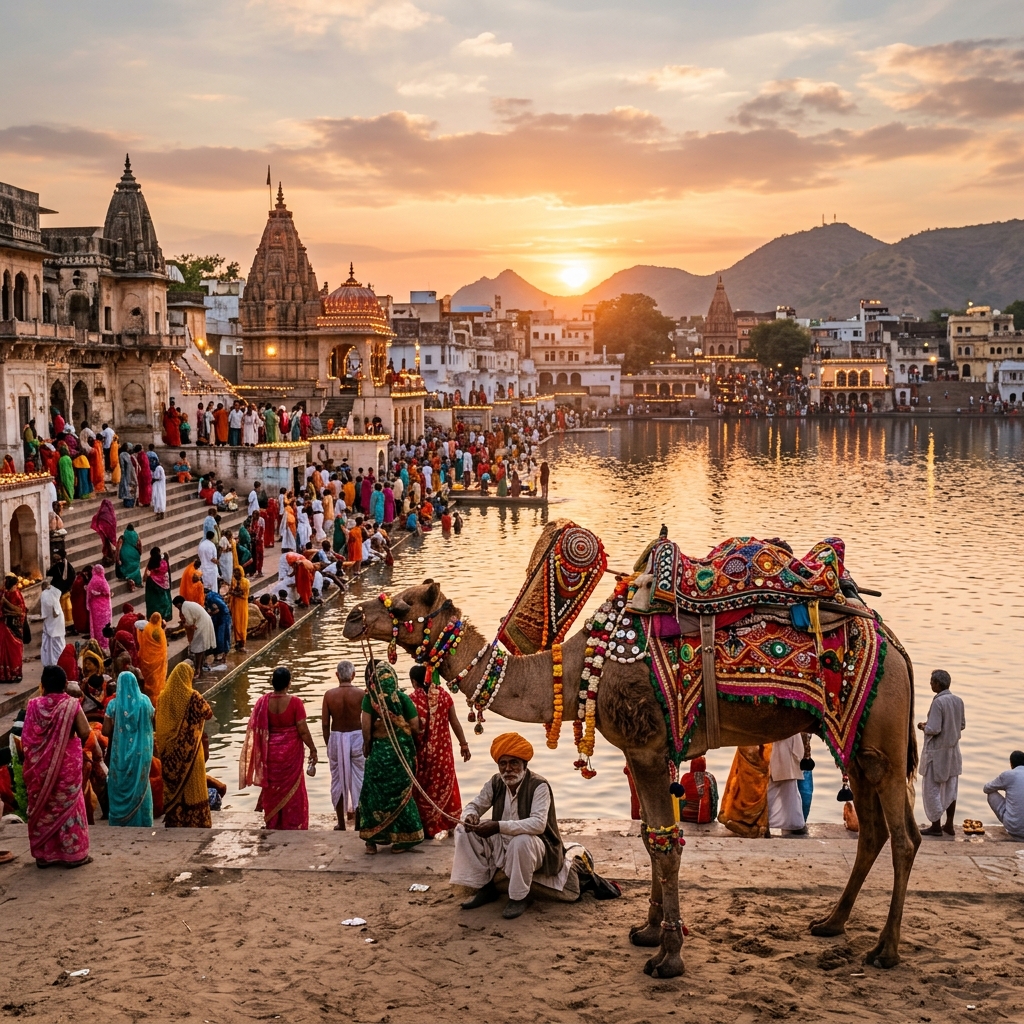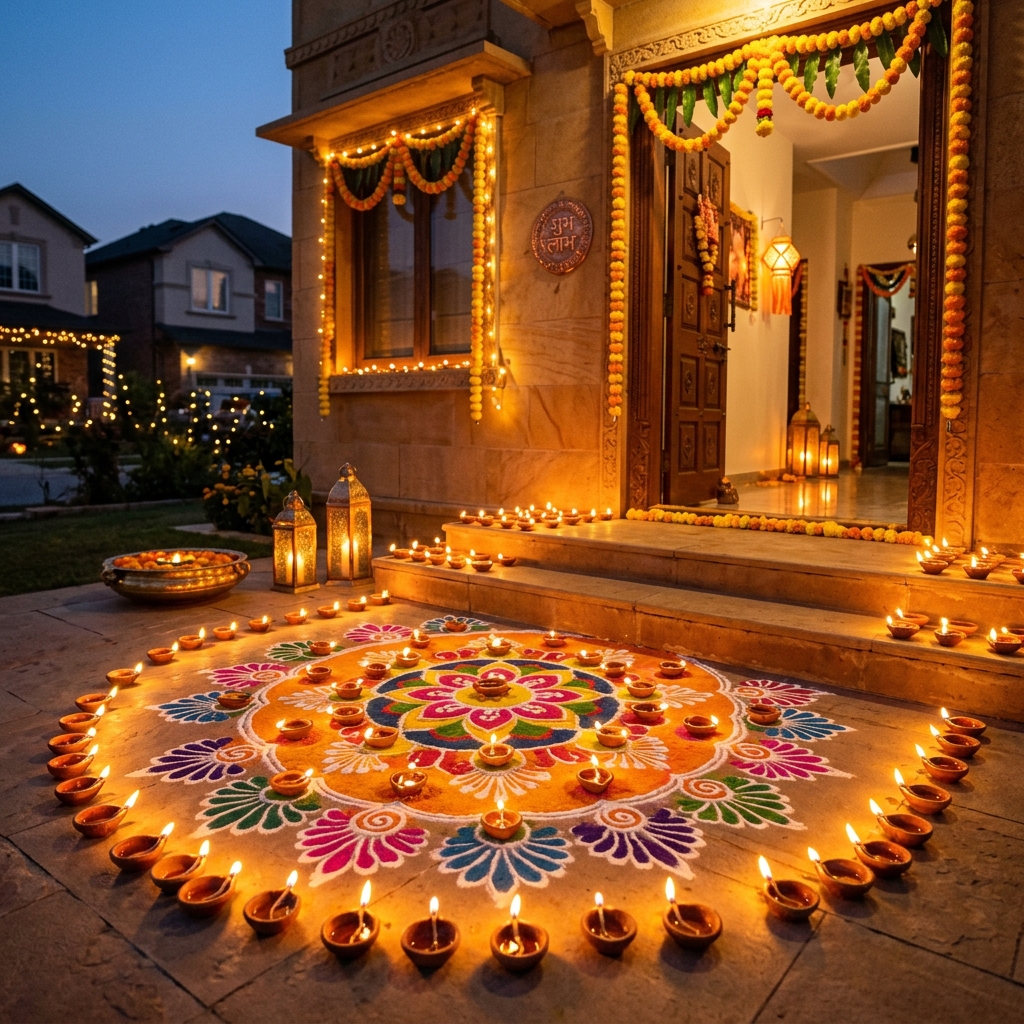
Ganesh Chaturthi starts today, 14 September 2026, and if you have ever seen photographs of a giant elephant-headed idol being carried into the sea through a crowd of a hundred thousand people, that is this festival. It is also, in most of North India, a much quieter affair than those pictures suggest. Visitors who arrive expecting Mumbai and find themselves in Rajasthan are sometimes puzzled, so here is what you will actually see, and where.
What is being celebrated
Ganesh — Ganapati, Vinayaka — is the elephant-headed son of Shiva and Parvati, remover of obstacles and the god you pray to before beginning anything. Chaturthi, the fourth day of the waxing moon in the month of Bhadrapada, is his birthday. Families and neighbourhoods install clay images of Ganesh, worship them for anywhere from a day and a half to ten days, and then carry them to water for immersion, known as visarjan. The largest immersions happen on Anant Chaturdashi, the tenth day, which in 2026 falls in the last full week of September.
Before any of that there is a lot of food. Ganesh's favourite sweet is the modak, a steamed or fried dumpling filled with coconut and jaggery, and sweet shops everywhere are full of them.
Mumbai: the festival at full scale
Mumbai is where Ganesh Chaturthi became the enormous public event it is today, and nowhere else comes close. Thousands of neighbourhood associations build pandals, some of them multi-storey sets with idols several metres tall. A few are famous in their own right. Lalbaugcha Raja, in central Mumbai, draws queues that can run to many hours; devotees join them overnight.
What a visitor sees:
- Pandal-hopping in the evening, when the lighting is on and the crowds are out. It is loud, cheerful and very safe in the way that very crowded, very family-oriented events tend to be.
- Drumming troupes and processions every day, as smaller household and society idols are taken for immersion on the second, fifth and seventh days.
- Anant Chaturdashi, when the big idols make their way to Girgaon Chowpatty and the other beaches. The processions start in the afternoon and carry on through the night into the next morning.
Honest caution: on the main immersion day the city's roads effectively close, and a car is useless. If you want to see it, choose a hotel you can walk from, and do not plan an airport run that day.
Pune: the same festival, easier to follow
Pune's celebrations are almost as old as Mumbai's and more compact. The five traditional "manache" Ganapatis lead the immersion procession in a fixed order, and the Dagdusheth Halwai Ganapati temple is lit spectacularly for the ten days. For a visitor, Pune is manageable in a way Mumbai on Anant Chaturdashi is not.
Jaipur and Rajasthan: devotional, not theatrical
In Rajasthan, Ganesh Chaturthi is mostly a temple and household festival. There are pandals in some neighbourhoods, and more each year, but nothing on Maharashtra's scale.
The centre of it in Jaipur is the Moti Dungri Ganesh Temple, below the small hill fort of the same name. On Chaturthi the temple draws enormous queues from early morning, the surrounding roads fill with a fair of stalls, and families bring laddoos as offerings. It is a genuine local occasion, and a visitor is welcome to join the queue as long as they are dressed modestly and patient. The temple also holds a fair every Wednesday, Ganesh's day, which is a smaller version of the same thing year-round.
Look out, too, for the image of Ganesh above the doorways of old houses and shops in the walled city, and on the gates of Amber Fort, where Ganesh Pol is named after him. In Rajasthan he is part of the architecture rather than just the calendar.
Elsewhere in India
- Hyderabad builds one of the tallest Ganesh idols in the country each year at Khairatabad, and its immersion procession to Hussain Sagar lake is one of the largest outside Maharashtra.
- Goa keeps it a family festival. Idols are installed at home, relatives travel back to their villages, and the celebration is much more domestic than public.
- Delhi has a growing number of community pandals, especially in neighbourhoods with Marathi and South Indian communities, but you have to know where to look.
What to eat
Modak first: the steamed ukadiche modak, filled with fresh coconut and jaggery, is the Maharashtrian classic, and sweet shops sell fried and chocolate versions alongside it. In Rajasthan the offering of choice is the besan or motichoor laddoo, which is what you will see stacked at Moti Dungri. Many families eat vegetarian food during the festival days, and street stalls near large pandals do a brisk trade in vada pav, pav bhaji and sugarcane juice.
Is September a good time to travel for it?
It depends where. Mumbai in September is still the tail of the monsoon: humid, with heavy showers possible. Rajasthan is warm and green, with occasional rain, lower hotel prices and far fewer visitors than in winter. We think it is an underrated month for the state, with the honest caveat that some afternoons are hot. Our month-by-month guide goes into the detail.
If festivals are the point of your trip, the autumn has a sequence worth knowing. Ganesh Chaturthi in September is followed by Navratri and Dussehra in October (we wrote about those in Navratri and Dussehra 2026 in Rajasthan) and then Diwali on 8 November. Our guide to where to celebrate Diwali 2026 covers the last of the three.
How to be a good guest
- At pandals and temples, remove shoes where others do and cover shoulders and knees.
- Ask before photographing people at prayer. Photographing the idols themselves is usually welcome in public pandals and often not permitted inside temples.
- If you are offered prasad — a sweet that has been offered to the god — accept it with your right hand.
- In immersion crowds, keep valuables minimal, agree a meeting point with your group, and stay near the edge rather than the front.
Common questions
When is Ganesh Chaturthi in 2026?
It begins on Monday 14 September 2026. Households immerse their idols after one and a half, five, seven or ten days, and the largest immersions take place on Anant Chaturdashi, the tenth day, in the last full week of September.
Where is the best place to see Ganesh Chaturthi?
Mumbai for scale, Pune for a slightly calmer version of the same thing. In Rajasthan, the Moti Dungri temple in Jaipur is the place to see the devotional side.
Can tourists take part?
Yes. Pandals are public and visitors are welcome to look, queue for darshan and accept prasad. Many neighbourhood groups are delighted to explain their idol and its story.
Is it crowded and noisy?
In Mumbai and Pune, extremely, especially in the evenings and on immersion days. In Jaipur, only around Moti Dungri on the day itself.
Travel with the festivals
We build routes around India's festival calendar every year, from quiet temple days in Jaipur to the great November fairs. See the options on our Golden Triangle with Mumbai tour, or tell us your dates and we will send a day-by-day itinerary and a price within 24 hours.